
How to Convert ASB Bank Statements to Excel and CSV
A step-by-step guide to turning your ASB statements into usable spreadsheet formats, built for New Zealand.
ASB gives you more export choices than most New Zealand banks, four in fact, including TDV, a tab delimited format almost nobody else offers. The catch is that all of them live in FastNet Classic on a desktop. Open the mobile app and your only option is a PDF.
This guide explains what ASB actually exports, which format is worth choosing, and how StatementSheet turns your ASB PDF statements into clean Excel or CSV files.
Can You Download ASB Bank Statements Directly in Excel or CSV?
Short answer: yes, in four formats, but only from FastNet Classic on a desktop. The mobile app offers PDF only.
ASB has a long record of moving first in New Zealand: it launched the country's first internet banking, FastNet Classic, back in 1997, and was the first to let customers stop paper statements in 2003. That heritage shows in its export options. From Search and Export in FastNet Classic, you pick an account, set a date range and choose your format.
The format list is unusually long: CSV, QIF, OFX and TDV. That last one, tab delimited values, is rare among banks and useful if your software chokes on commas inside descriptions. Practical, but only if you know it is there.
The limitation is the device. All of this is desktop only. In the ASB mobile app you can open Accounts, tap the three dots beside an account name and download statements, but what you get is a PDF. Statements themselves live in the Document Centre, under Documents. For a spreadsheet from those PDFs, conversion is the direct route.
Why Convert ASB PDF Bank Statements to Excel or CSV?
The export is rich but desktop bound, and statements only come as PDFs. Converting bridges that:
- Get a spreadsheet from your phoneThe CSV, QIF, OFX and TDV export needs FastNet Classic on a computer. From the mobile app you can only download a PDF statement, and converting it gives you the same spreadsheet result.
- Turn statements into data, not just documentsStatements in the Document Centre are PDFs by design, meant for reading and record keeping. Converting them turns a year of documents into rows you can sort, filter and total.
- Skip the format decision entirelyFour export formats sounds generous until you have to pick one. Converting the PDF sidesteps the choice and gives you a formatted workbook that opens anywhere.
- Prepare the New Zealand tax yearThe tax year runs 1 April to 31 March, which cuts across statement periods. A converted spreadsheet lets you filter that exact range rather than stitching months together.
- Import into Xero, MYOB or HnryA clean CSV imports straight into Xero, MYOB or Hnry for reconciliation, without hand-fixing columns or date formats first.
Search and Export vs. PDF Statement: Which Should You Use?
ASB splits raw transaction export from the statement document. They serve different purposes.
| Critère | Search and Export (CSV/QIF/OFX/TDV) | PDF statement (converted) |
|---|---|---|
| Available on mobile | No, FastNet Classic on desktop only | Yes, from the app or the web |
| Formats offered | Four, and you must choose | One route, a formatted workbook |
| Formatted .xlsx workbook | No | Yes, after conversion |
| Official document | No, a transaction extract | Yes, the statement stands as the record |
| Best for | Feeding accounting software | Tax year, audits, sharing with an accountant |
Simple rule: If you are at a computer and your software wants a specific format, use Search and Export. For a workbook, or if you bank from your phone, convert the PDF statement.
Why Use StatementSheet?
StatementSheet reads your ASB PDF statement and turns every transaction line into a structured spreadsheet row, with no copying, pasting or manual cleanup.
- ✔️ Produces a spreadsheet from statements downloaded on any device, including the app
- ✔️ Turns Document Centre PDFs into sortable, totalled rows
- ✔️ Delivers a formatted .xlsx workbook rather than a plain interchange file
- ✔️ Columns for Date, Description, Withdrawals, Deposits and Balance, with wrapped descriptions merged
- ✔️ Handles New Zealand date formats and NZD amounts correctly
- ✔️ Ready for Xero, MYOB, Hnry and Excel
- ✔️ Scanned statements handled by OCR, with files processed securely
Which ASB Documents Can You Convert?
ASB serves personal, business and rural customers across New Zealand. StatementSheet handles:
- ASB everyday and savings account statements in PDF
- ASB credit card statements
- ASB business and rural account statements
- Statements downloaded from the ASB Document Centre
- Scanned or archived paper ASB statements
How to Convert ASB PDF Bank Statements in Four Easy Steps
Here is how to turn your ASB PDF statements into Excel or CSV:
Step 1: Download Your ASB PDF Statement
- Log in to ASB FastNet Classic, ideally in a desktop browser
- Open Menu at the top left, then select Documents on the right-hand side
- In the Document Centre, set the time period and choose Statements as the document type
- Click a statement to preview it, then click Download to save the PDF
From the ASB mobile app the path is shorter: open Accounts, tap the three dots next to the account name and choose Download statements. Note that the raw export in CSV, QIF, OFX or TDV lives under Search and Export in FastNet Classic and is desktop only.
Step 2: Upload Your PDF Bank Statement

Step 3: Our engine converts it into a structured Excel or CSV file

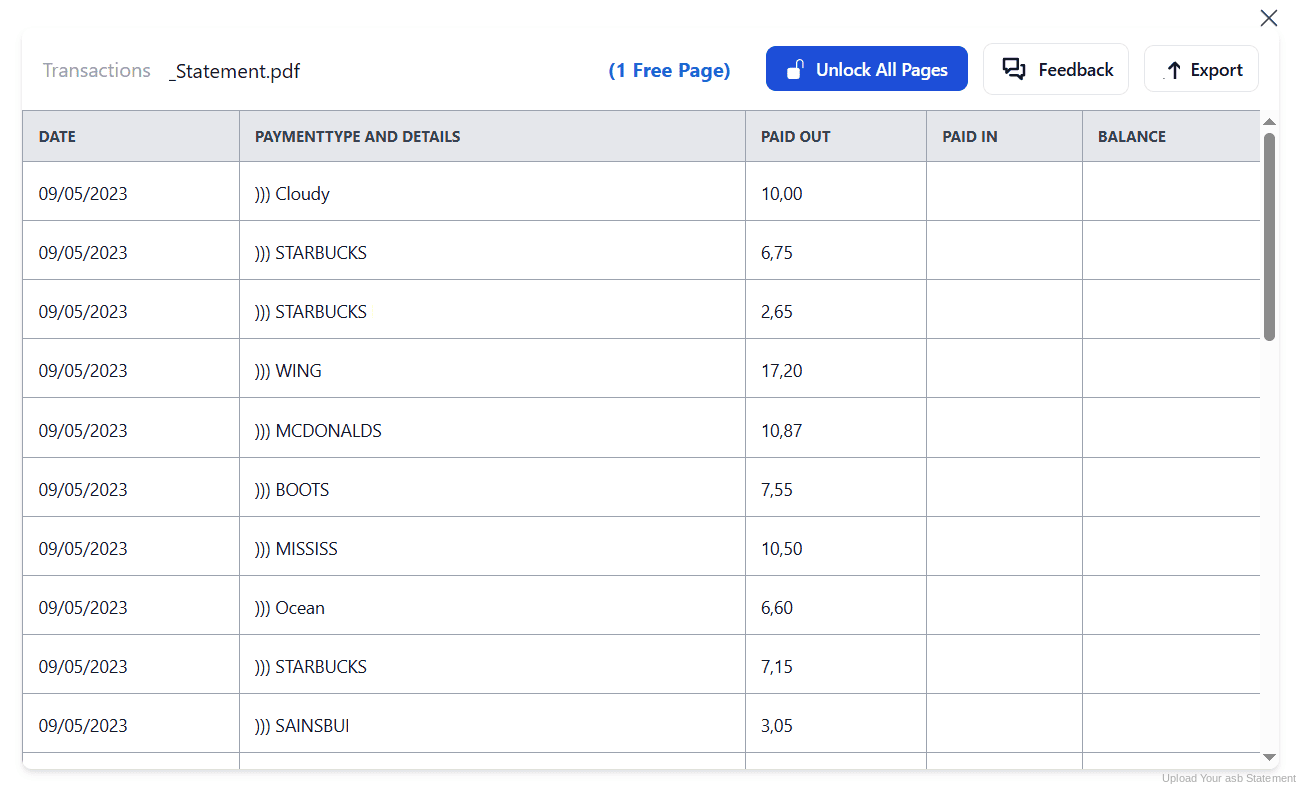
Step 4: Check the result and download your converted file instantly
Can You Convert ASB Statements Manually?
You can, but you will meet two obstacles. First the device: the export is desktop only, so from a phone there is nothing to copy but a PDF. Second the formats: QIF and OFX are meant for accounting software, and TDV is tab delimited, which a spreadsheet will misread unless you tell it exactly how to split the columns.
Copying from the PDF brings the familiar problems: columns drifting at page breaks, descriptions wrapping onto a second line, and amounts arriving as text rather than numbers. Over a full tax year that is hours of cleanup for a file you will use once.
An automatic converter reads the statement, merges wrapped descriptions and rebuilds Date, Description, Withdrawals, Deposits and Balance as real columns. Check your totals against the closing balance afterwards to confirm the result.
Related Guides
More New Zealand Bank Guides:
Frequently Asked Questions
How do I export ASB transactions to CSV?
In FastNet Classic, select Search and Export on the left-hand side, choose the account and date range, then pick your format from the Export Format dropdown and click Export. CSV, QIF, OFX and TDV are all available.
What is the TDV format ASB offers?
TDV stands for tab delimited values. It separates columns with tabs rather than commas, which helps when transaction descriptions themselves contain commas. Most other banks do not offer it.
Can I export to CSV from the ASB mobile app?
No. The export is only available in FastNet Classic on a desktop. From the app you can open Accounts, tap the three dots beside the account name and download statements as PDFs, which you can then convert.
Where are my ASB statements stored?
In the Document Centre. Open Menu at the top left, select Documents, set the time period and choose Statements as the document type. Click a statement to preview it, then Download.
Does ASB give me a real Excel file?
No. The export produces CSV, QIF, OFX or TDV, which are interchange formats rather than a formatted .xlsx workbook. Converting the PDF statement produces a proper workbook with typed columns.
Can I use converted statements for my New Zealand tax return?
Yes. The tax year runs 1 April to 31 March, and a converted spreadsheet lets you filter that exact range and import it into Xero, MYOB or Hnry.
Tips for Organizing Your Converted ASB Statements
Once your statements are converted to Excel or CSV, here is how to get the most out of them:
- Pick TDV when descriptions contain commasIf your transaction descriptions include commas, a CSV can split them into the wrong columns. ASB's TDV format uses tabs instead, which avoids the problem entirely.
- Download from the app, convert on any deviceThe raw export needs a desktop, but statements download from the app in seconds. Save the PDF there and convert it: the result is the same spreadsheet.
- Line your file up with the tax yearNew Zealand's tax year runs 1 April to 31 March. Once converted, filter that range in one step rather than stitching monthly statements together by hand.
- Reconcile against the closing balanceCompare your converted totals with the opening and closing balances printed on the statement. If they disagree, a row is missing or duplicated.
- Keep records for seven yearsInland Revenue requires business records to be kept for seven years. Keep the original PDF: in a review it is the source document that counts, not your spreadsheet.
Troubleshooting Common ASB Conversion Issues
- You cannot find Search and Export on your phoneThat feature is part of FastNet Classic on a desktop browser. From the app, open Accounts, tap the three dots beside the account and download the statement PDF, then convert it.
- Your TDV file opens as one long columnTDV separates columns with tabs, so your spreadsheet must be told to split on tab rather than comma. Import it through the data import dialogue, or convert the PDF statement instead.
- Descriptions are split across the wrong columnsA description containing a comma can break a CSV. Either use ASB's TDV format, or convert the PDF, where descriptions stay intact in a single cell.
- Amounts are not adding upPasting from a PDF usually turns amounts into text. A clean conversion returns them as numbers you can calculate with straight away.
Final Thoughts: Take Control of Your Financial Data
ASB offers four export formats, more than most New Zealand banks, and even the uncommon TDV. But all of it is locked to FastNet Classic on a desktop, and the mobile app gives you PDFs alone.
With StatementSheet, your ASB PDF statements become clean Excel or CSV files: separate columns, merged descriptions, NZD amounts that calculate properly, ready for the tax year and your accountant.
Ready to convert your ASB bank statement to Excel or CSV?
➡️ Ready to convert bank statement PDF to CSV? and skip the format decision entirely.